
Life involves tradeoffs: Time or money. Speed or quality. Ketchup or mustard.
The same tradeoffs are true of technology — and pretty much all goods and services. Historically, you were able to have something good, cheap, or fast, but you couldn’t really have all three at once.
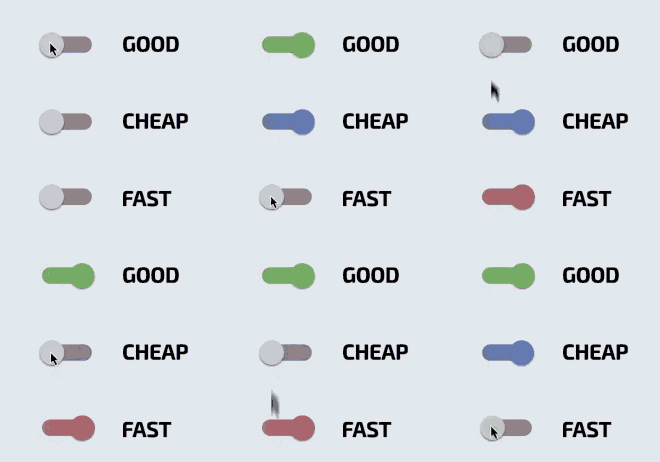
The iPhone is the best handset (good and fast), but it’s hecking expensive. Facebook is a free and fast way to stay connected with people you went to high school with twenty years ago, but it’s not particularly good. You can access internet for free while flying through the sky at 500 mph, but it’s not especially fast.
These ideas are true of software, but they’re also true of pretty much anything that involves somebody making or doing something for you. Work can be done quickly, well, or cheaply, but there’s a reason you can’t have a hand-tailored suit made overnight for $200. Something’s gotta give.
Which is what makes AI kind of mind-blowing. ChatGPT and Claude and myriad other AI tools are fast, free, and excellent. They are paradigm shifting tools that are not constrained by the historical good/cheap/fast paradigm.
A thought experiment:
There could easily be a world in which ChatGPT was still free and comprehensive, but you might need to submit your query and wait five minutes for it to be processed, á la dialup access in 1999.
Or that it was fast and free, but not actually good, like Internet Explorer in 2004.
Or that it was fast and comprehensive, but cost $70/mo, like cell service in 2008.
But the crazy thing is, with AI, there are very few compromises. Sure, it occasionally hallucinates information (not good), and sometimes hangs (not fast), or you max out your credits (not free), but the basic experience is one that does not entail compromise, which feels as-yet unprecedented for something that so fundamentally changes the way we move through the digital world.
There are a lot of concerns around AI, and I’m hardly the person to address those. My concern is around human expectations of technology, and also in a way, of things that aren’t technology. When you have a service that can access the sum total of human information, write entire novels, compose symphonies, build business plans, write legal documents, and analyze the human genome in a matter of seconds, anywhere, and basically for free — what becomes of our expectations of things that aren’t software?
*One could make the argument that historically, tools like Google Search or Wikipedia or Whatsapp did hit the trifecta of being good, fast, and free, and I don’t discount the magic an internet user would have felt in 1998 when using Search for the first time. But I would argue that they do not represent the same multi-vector paradigm-shift that AI does.
 Silicon Spatula